
Effective waterproofing for sub-grade structures requires a shift from standard moisture protection to precision-engineered hydrostatic pressure management. For specialty applications like elevator pits, tunnels, and retaining walls, success is defined by the integration of high-performance membranes with structural engineering principles. These confined or high-stress environments demand solutions that go beyond simple coatings, utilizing PE-stamped designs that account for soil chemistry, water table fluctuations, and long-term structural movement.
The Critical Nature of Elevator Pit Waterproofing
Elevator pits represent one of the most challenging environments in commercial construction. Located at the lowest point of a building, these pits act as natural collection points for groundwater. Because they house sensitive mechanical components and electrical systems, even minor seepage can lead to catastrophic equipment failure, code violations, and significant liability.
Managing Hydrostatic Pressure
In many regions, the water table sits well above the base of the elevator pit. This creates hydrostatic pressure—the force exerted by standing water against the concrete slab and walls. Standard damp-proofing is insufficient here. Industry best practices dictate the use of robust, positive-side waterproofing systems applied to the exterior during construction. For existing structures experiencing leaks, negative-side crystalline waterproofing or chemical grout injection becomes necessary to create an internal capillary seal within the concrete matrix.
Regulatory and Code Compliance
Building codes and elevator safety standards (such as ASME A17.1) are stringent regarding water accumulation. A flooded pit is not merely a maintenance issue; it is a regulatory failure. Engineers must specify systems that are resistant to common soil contaminants and hydrocarbons, ensuring the integrity of the barrier remains uncompromised over the building’s lifecycle.
Engineering Resilience in Tunnel Waterproofing
Tunneling projects—whether pedestrian, utility, or transit—face unique environmental stressors. Unlike a standard foundation, a tunnel is often entirely submerged or subjected to varying geological pressures along its length. Tunnel waterproofing must be viewed as a continuous, monolithic envelope designed to withstand dynamic loads.
Segmental vs. Cast-in-Place Challenges
The method of tunnel construction dictates the waterproofing approach. For pre-cast segmental tunnels, the focus remains on the gaskets and joints, where precision-engineered EPDM seals are the primary line of defense. In cast-in-place applications, heavy-duty sheet membranes (such as HDPE or PVC) are typically employed. These systems must be “fully bonded,” meaning the membrane chemically or mechanically integrates with the pouring concrete to prevent lateral water migration between the structure and the barrier.
Durability and Service Life
Tunnels are often designed for a 75-to-100-year service life. Therefore, the material selection process must be data-driven. Engineers evaluate the pH levels of the groundwater and the presence of sulfates or chlorides, which can degrade inferior materials. A failure in tunnel waterproofing is notoriously difficult and expensive to remediate, making the initial design-build phase the most critical window for risk mitigation.
Retaining Wall Waterproofing: Beyond Surface Protection
Retaining walls are frequently overlooked in the broader waterproofing scope, yet they are essential for the structural preservation of a site’s topography. The primary challenge with retaining wall waterproofing is not just keeping water out, but managing how water moves behind the wall.
Drainage Composites and Hydrostatic Relief
A retaining wall that holds back water-saturated soil is at risk of structural collapse due to the immense weight of the “hydrostatic head.” Best practices involve a dual-layer approach:
- The Primary Barrier: A high-build fluid-applied or sheet membrane that protects the concrete from moisture-induced rebar corrosion.
- The Drainage Plane: A geocomposite drainage board that directs water down to a perforated footing pipe (French drain).
By providing a path of least resistance, these systems relieve the pressure on the wall, ensuring that the waterproofing membrane is not forced to do the work of a structural reinforcement.
Blind-Side Applications
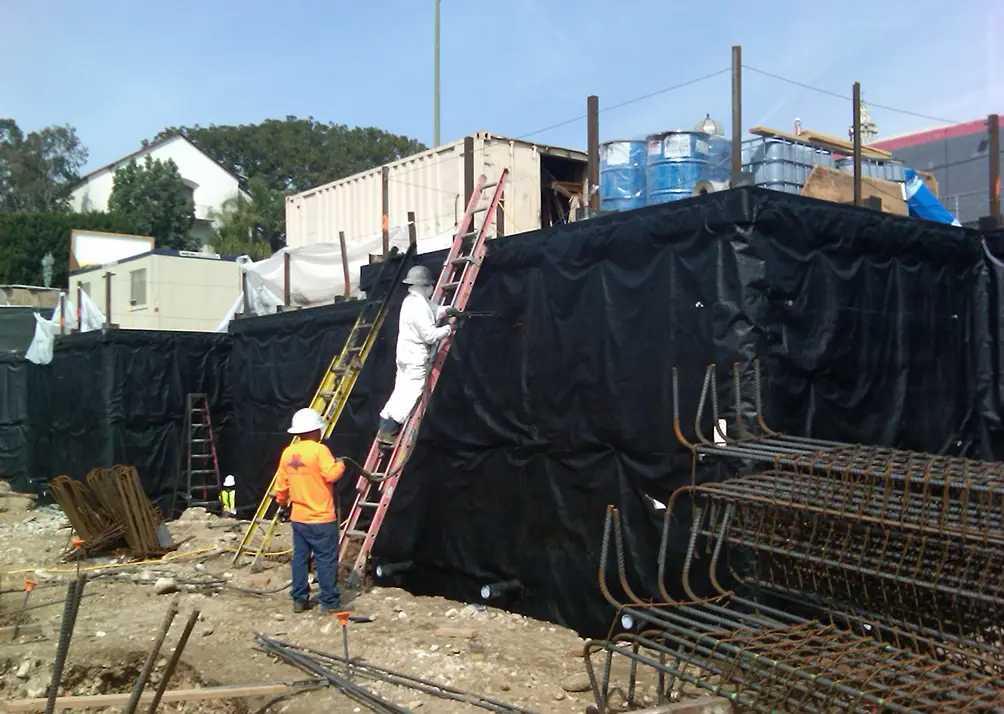
In dense urban environments where property lines are tight, “blind-side” waterproofing is often required. This involves installing the waterproofing membrane against the shoring system before the retaining wall is poured. This requires a high degree of technical precision, as the membrane must remain intact during the reinforcement tie-in and the concrete pour, ultimately bonding to the wall to create a seamless seal.
Data-Driven Selection and Specification
The transition from a standard dry-stack or poured wall to a high-performance sub-grade structure requires a sophisticated understanding of material science. When specifying products for these specialty applications, industry professionals look for several key performance indicators:
- Permeance Ratings: Ensuring the material effectively stops vapor and liquid transmission.
- Tear and Puncture Resistance: Vital for the rigors of a construction site.
- Chemical Compatibility: Ensuring the membrane won’t degrade when in contact with contaminated groundwater or soil.
For complex projects involving brownfields or high-density urban infill, the integration of these systems is best handled by specialists who understand the intersection of environmental mitigation and structural integrity. Advanced Construction Technologies (ACT) provides the PE-stamped designs and technical precision required to execute these specialty applications. By prioritizing engineering excellence and regulatory fluency, ACT ensures that elevator pits, tunnels, and retaining walls remain dry and compliant for the duration of their intended lifespan.